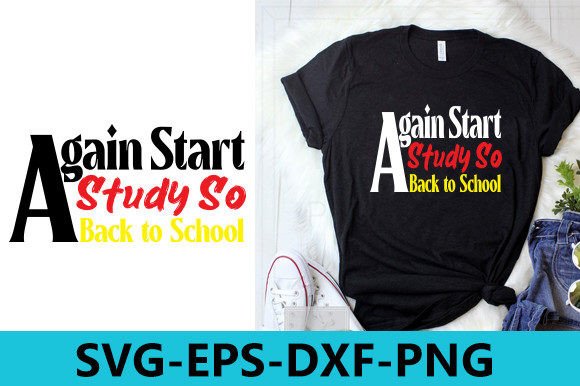
Again Start Study Back to School
As a designer who’s stitched hundreds of back-to-school projects—from embroidered lunchbox totes for local teachers to custom sweatshirts for college clubs—I opened Again Start Study Back to School expecting cheerful energy, not cliché. What I found was a clean, confident graphic that breathes life into the “fresh start” feeling without leaning on overused icons like apples or pencils. It’s got rhythm in its lettering, subtle balance in its spacing, and just enough visual personality to feel handmade—not templated.
A Design That Fits Real Life, Not Just Mockups
Last week, I used Again Start Study Back to School as the centerpiece for a linen tea towel set bound for a boutique’s back-to-school launch. The design sat perfectly centered above a folded corner hem—no awkward cropping, no cramped letters. Its layout naturally invites stitching on flat, stable surfaces: tote bags, pillow covers, aprons, and kitchen towels all held the detail well. On a lightweight cotton sweatshirt? It read clearly at 4.5 inches wide—no blurring, no thread nesting in tight curves. That tells me the stitch density is thoughtfully managed, not overloaded.
Where it shines brightest is in personalized gifts. A client ordered three baby onesies—navy, heather gray, and oatmeal—with Again Start Study Back to School resized to 3.2 inches across the chest. The letterforms stayed crisp. No satin stitch bleed. No tiny “a” or “o” collapsing under tension. That’s rare in school-themed graphics, which often sacrifice legibility for whimsy.
Where to Use It—and Where to Pause
Again Start Study Back to School is built for clarity, not complexity. That makes it ideal for:
- Custom apparel (t-shirts, crewnecks, denim jackets)
- Embroidered patches (great for iron-on or sew-on school spirit kits)
- Tote bag designs—especially natural fiber or canvas with medium texture
- Baby embroidery on onesies, burp cloths, and nursery pillows
- Holiday embroidery—think “First Day of Kindergarten” keepsakes or teacher appreciation gifts
But be mindful: this isn’t a high-detail applique design. There are no layered elements, no intricate borders or shadow effects. So if you’re planning dense fill-stitch backgrounds or multi-step satin-stitch outlines, Again Start Study Back to School won’t deliver that depth—it’s a strong, standalone graphic, not a decorative system.
It also doesn’t scale down gracefully below 2.7 inches. I tested it on a curved cap front at 2.2 inches and saw slight letter distortion—especially in the “g” and “y.” For caps or curved surfaces, stick to 3 inches minimum and use a tear-away + cut-away stabilizer combo. Also avoid thin, stretchy knits unless you’ve pre-tested tension and backing. The design’s clean lines rely on stability—not forgiveness.
What It Adds to Your Finished Product
Customers don’t buy embroidery files—they buy meaning, memory, and mood. Again Start Study Back to School lands that emotional note with sincerity. It feels optimistic but grounded. Not childish. Not corporate. Just warm, capable, and quietly proud—like a student holding their first syllabus.
That tone elevates your handmade product instantly. When an Etsy seller uses it on a linen pencil pouch, buyers see intention—not just decoration. When a craft fair vendor stitches it onto a canvas backpack, it reads as thoughtful branding, not filler text. And because the file includes EPS, SVG, DXF, and PNG formats, it’s easy to prep for digital embroidery files, printable mockups, or even vinyl-cut versions for hybrid crafters.
Crucially, it supports brand consistency. Whether you’re building a small shop product line around “learning milestones” or curating a seasonal collection for teachers, Again Start Study Back to School holds its own alongside other quality Graphics assets—no awkward scaling, no inconsistent weight, no mismatched kerning.
Practical Designer Notes Before You Stitch
Before loading Again Start Study Back to School into your machine or listing it in your shop:
- Test on scrap fabric first—especially if using textured or dark fabric. Check how thread colors interact with background tone.
- Review stitch density in your embroidery software. Look for any unusually dense clusters that might cause puckering on lightweight cotton.
- Confirm hoop size compatibility. At standard sizing (4–4.5"), it fits comfortably in a 5x7 hoop—but verify before stitching on production runs.
- Inspect small details in the PNG preview: check corners of letters, spacing between “S” and “t”, and clarity of the lowercase “a”. These define legibility.
- Test black-and-white mockups. Does it hold contrast on light and dark fabric equally? I found it worked best with medium-contrast thread pairings—navy on oatmeal, charcoal on cream—not stark black-on-black.
- Use proper stabilizer. Medium-weight cut-away works for most apparel; tear-away + light iron-on is ideal for tea towels and baby items.
- Check licensing terms before selling finished products or reselling the digital embroidery file. This is especially important for Etsy sellers and craft business owners.
One final note: while the description says “Possible and easy change col,” remember that color flexibility depends on how the file was digitized. If you plan to recolor heavily—say, switching from navy thread to metallic gold—review the stitch path in your software first. Some letterforms may need minor re-digitizing for optimal flow.
Final Thought: A Quietly Confident Choice
Again Start Study Back to School won’t shout. It won’t dazzle with glitter or gradients. But it will land—clean, clear, and emotionally right. For crafters building trust through consistency, for Etsy sellers curating meaningful collections, and for designers who know that great embroidery starts with smart, usable design assets—it’s a reliable, human-centered pick. Not flashy. Not fussy. Just ready to stitch.